Creating developer-focused content on YouTube is one of the most effective ways to build a brand, share knowledge, and grow an audience. The best part? You don't need to be an expert to get started.
What you do need is the right mindset, a clear focus, and a willingness to learn from what already works. This guide covers the fundamentals—strategy, content styles, and what the algorithm actually cares about.
Start with the right mindset
Forget the idea that you need to be a 10x engineer or have years of experience. You don't. Many successful creators are simply good at learning in public, sharing insights, and staying consistent.
Focus on being yourself and presenting things from your unique perspective. Don't try to invent a new style or format if you're not ready to experiment and iterate heavily. The truth is: copying what works is not only okay, it's the fastest way to get results, especially when you're starting out.
Define your channel type
Before uploading your first video, clearly define what kind of channel you're building. Are you creating content as an individual creator or representing a brand?
While this distinction used to significantly impact channel style, today the tone and editing should generally be similar, regardless of whether you're an individual or a brand. Audiences resonate more with channels that feel like a personal brand.
If you're building a channel for a company, the key difference lies in strategy. Your primary goal will likely be converting viewers into customers, so finding effective ways to market your product within the content is crucial.
Founder-led vs. team-led brand channels
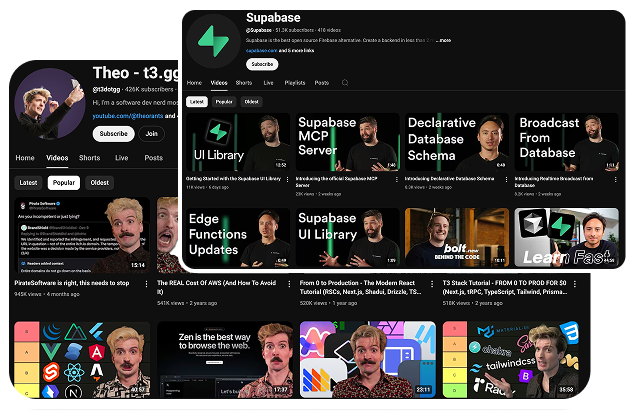
Founder-led: If the company founders have the time and inclination, creating content under their name can be highly effective. Think Theo Browne with t3.gg—adding the company brand next to his name. This approach builds a personal connection while still associating the content with the company.
Team-led or faceless: If founders aren't involved, ensure the content presentation isn't tied to a specific personality. This makes it easier for different team members to contribute over time. Focus on the topic, clearly state the presenter's role within the company, and consider a faceless approach. Faceless channels, while potentially less relatable to a single person, offer flexibility and are easier to scale with multiple contributors.
Pick a content direction and stick with it
Your content should have a strong identity. Whether you're teaching people how to code, sharing your journey through the tech industry, talking about developer tools, or building visual CSS demos—pick a direction and commit.
The most successful channels are consistent. Their audience knows exactly what to expect from every video.
Some of the most popular styles include:
- Basic coding tutorials
- Commentary and news from the dev world
- Career advice for junior to senior developers
- Tech storytelling
- Creative projects with code
Once you've committed to a content type, lean into it. Over time, this focus becomes your brand, and people subscribe because they want more of that specific thing.
A few channel examples
Take Fireship as a perfect example of brand consistency. Every video has a clear structure, pacing, tone, and aesthetic. The channel has become known for fast-paced, meme-infused explainers that developers can rely on for quick learning and laughs.
Honeypot (now CultRepo) takes another route: tech-focused storytelling. It tells the untold stories behind popular libraries, tools, and the people who built them. Each video feels like a mini-documentary, with high production value and strong narrative.
Both succeed because they commit to their format.
Choose: face or faceless
There are two major routes for dev content on YouTube: becoming a recognizable personality or creating a faceless, format-driven channel. Both can work, but one is definitely more beginner-friendly.
Becoming a developer influencer
If you're comfortable on camera and have strong opinions, showing your face might work well. The benefit is that people watch for you—your story, your delivery, your take on things.
But becoming a recognizable face takes time and effort. You need to show up consistently, build a presence, and be engaging. Some great examples are Theo Browne (t3.gg) and ThePrimeagen.
Theo, with a background at Twitch, leveraged both technical knowledge and understanding of how online content works. He built a fast-growing brand through sharp, opinionated takes and repurposing content from his livestreams.
ThePrimeagen did something similar, drawing from his time at Netflix and his unique personality to become one of the most-watched dev creators today. Both used livestreaming to their advantage, creating long-form content that could later be cut down and redistributed.
If your background and charisma match that level, go for it. But for most people starting out, a faceless channel is the better bet.
The faceless route: Fireship style
The Fireship format has become a genre of its own. It's short, high-paced, visually dynamic, and packed with developer insight and humor. You never see the creator's face, but the voice and editing style are instantly recognizable.
Jeff Delaney (creator of Fireship) even made a video explaining how he makes videos for programmers—worth watching if you're considering this route.
Many channels have adopted this style with great success:
These creators prove that you don't need years of video experience or even that many videos to make a big impact. Some channels have only a handful of uploads but have already generated hundreds of thousands of views. YouTube gives new channels a fair shot, so if your thumbnail, title, and format are tight, your first few videos can absolutely take off.
This format is flexible enough to work across different content types—tech explainers, commentary, storytelling, or creative demos. If you're unsure where to start, study these channels. Reverse engineer their pacing, structure, voiceover tone, and visual style.
How the YouTube algorithm actually works
There's a lot of myth around what YouTube's algorithm cares about. But according to people like MrBeast, it boils down to two core metrics:
Click-through rate (CTR): How many people click your video.
Average view duration (AVD): How long they keep watching.
That's it. If you can get people to click and keep them watching, your video will perform. Everything else—video length, posting schedule, metadata—is secondary.
And no, your videos don't have to be long. Fireship and its clones regularly post 2-4 minute videos that rack up hundreds of thousands of views. Length doesn't matter if your CTR and AVD are strong.
Designing thumbnails and titles that work
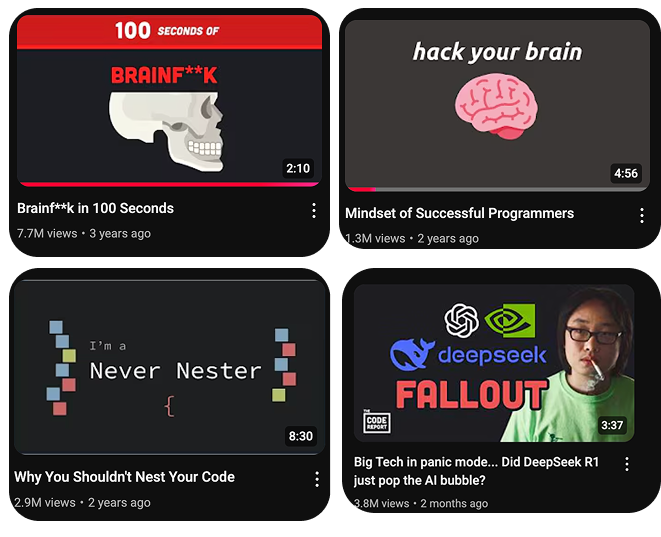
This is one area where copying is not just okay—it's smart. Look at what Fireship and similar channels are doing. Study their thumbnails and titles, and mirror their approach.
YouTube now allows A/B testing for thumbnails. Use that feature. Create two or three variations and see which one gets better clicks.
A few principles:
- Use bold fonts, high contrast, and simple visuals
- Make sure your thumbnail is legible even when tiny
- Your title and thumbnail should clearly communicate what the video is about
- Ideally spark curiosity
How to keep people watching
Getting clicks is only half the battle. You also need to hold attention.
The first 10-15 seconds are critical. Don't waste them. Don't open with a long intro or an ad for your product. Start fast. Introduce the topic and tell the viewer exactly why they should care. Preview the hook or the ending early on.
Editing matters a lot. Tight, fast-paced editing keeps people engaged. Cut out filler words, silences, and anything that slows the momentum. Use frequent jump cuts or zooms to reset attention every few seconds. Memes can help too (Fireship uses them heavily), but they're not required.
Learn from your analytics. See where people drop off and improve from there.
Final thoughts
If you're planning to create dev-focused content on YouTube, now's a great time. The space is growing, and developers are actively looking for content that educates, entertains, or inspires.
Start with a clear idea of who you are and what kind of content you want to make. Study what's working, copy it unapologetically, and improve over time. Focus on clickable thumbnails, tight hooks, and strong pacing. And above all, stay consistent.
Success on YouTube isn't about being the most original. It's about being consistent, clear, and good enough to keep people watching.